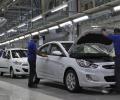
BS-VI emission norms and the COVID-19 lockdown impacted the dispatches.

Amid slowing volume sales among India's major automakers, Toyota Kirloskar Motor (TKM) has defied the trend with strong growth, driven by demand for hybrid vehicles and a reliable product line up. The company expects this momentum to continue in 2025. "The overall response to our cars has been fabulous. So, we foresee the same momentum in 2025 as well," Sabari Manohar, vice-president, sales-service-used car business, TKM, said.

Maruti Udyog, India's biggest carmaker, has been ranked first in customer satisfaction by international market research firm JD Power.

The price is expected to be around Rs 10 lakh, at par with competition.

Hyundai Grand i10 is the fastest growing car in India, says the company.
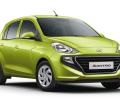
The new Santro, with a premium feel, is proof that when it comes to offering latest features and with it design at competitive prices, small cars are no longer shying away from entering a territory once occupied only by larger models, says Pawan Lall.

Bengaluru outpaced Mumbai, Delhi, and Pune in 2023 to become India's leading city for electric car registrations. The city's tech-savvy workforce, increased acceptability, zero road tax, subsidised electricity for EV charging, and a wide charging station network contributed to this surge. Electric car registrations in Karnataka's capital surged more than threefold in 2023 to 8,690 units, overtaking the growth witnessed in the other three cities, according to data from Jato Dynamics
Hyundai Motor India Ltd on Wednesday launched a new automatic variant of its diesel powered luxury sedan Sonata Embera CRDi, priced at Rs 15,71,656 (ex-showroom Delhi).

Hyundai Motor India will raise prices of its entire product portfolio in the range of Rs 5,000 to Rs 25,000 from Jan 2015.

Corporate India is starting to step up its capital expenditure plans amid government incentives and signs of rising demand, company executives and analysts have indicated. This coincides with the Reserve Bank of India (RBI) recently citing a double-digit growth in private capital expenditure. Healthy balance sheets of banks and corporates, along with increasing capacity utilisation and improving business sentiment, are contributing to a favourable environment for sustained growth in private sector investments, the RBI said in its policy last week.
With sales sagging despite discounts, car makers are now looking at value-added services to attract customers.

Tata Motors is looking to consolidate its position in the SUV segment as it marks its entry into the highly competitive mid-size space which is currently dominated by South Korean and Japanese carmakers. The Mumbai-based auto major on Monday launched midsize SUV coupe Curvv with petrol and diesel powertrains with a price starting at Rs 9.99 lakh. The company has already unveiled the electric version of the model in August.
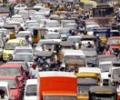
Absence of diesel options, economic slowdown hurt sales
General Motors, Nissan Motor India and Volkswagen managed to ride the tide with new launches.
While Maruti recorded negative sales, Hyundai gained marginally.

While the country's largest car maker, Maruti Suzuki India, said its car will become costly by two per cent, Hyundai Motor India said it will result in a price rise of Rs 6,500-25,000 on average.

Open order books in February breach 700,000; wait period for some models exceed a year.
The government seems to have come to the rescue of potential car buyers.
Automobile component manufacturers are rejoicing over a sudden 30-40 per cent spurt in demand in February. Analysts are, however, not entirely sure of the reason for this high growth; many are doubtful if it can be sustained, given the other gloomy signals. An analyst says, "Almost all car makers have either completely withdrawn or drastically reduced their promotional offers." Also, payment issues as far as vendors are concerned remains a problem.

The new year has brought good news for almost all car manufacturers, with market leader Maruti Suzuki, Hyundai Motors, Tata Motors, Mahindra & Mahindra, General Motors and even Fiat, posting their highest monthly sales since their inception.

Chinese electric carmaker BYD is focusing on launching vehicles in the Rs 25-45 lakh price range in India even as it continues to evaluate customer preferences and demand in more affordable segments, its Head of Electric Passenger Vehicles in India Rajeev Chauhan told Business Standard.
Issues relating to shortage of key automotive components, which were supposed to be sorted out a month ago, will hit production even for the next two quarters, as slow ramp-up and discrepancies in tyre prices impact output.

The concept of the rally organised by Hyundai was to promote fuel efficient driving habits among its customers.
Last month, nine leading vehicle manufacturers sold 213,633 units, 25.8 per cent more than last year.
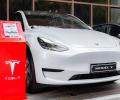
With India's EV penetration at just 2.5 per cent, the market presents an opportunity -- provided Tesla gets its pricing right.

Automobile retail sales in India rose 11 per cent in September as better supplies from manufacturers enabled dealers to ramp up customer deliveries amid the ongoing festive period, Federation Of Automobile Dealers Associations said on Tuesday. Last month, total retail sales stood at 14,64,001 units as compared to 13,19,647 units in September 2021. FADA noted that October is expected to witness even better overall sales due to the festive season further gathering steam.
Maruti Suzuki India and Tata Motors reported decline in sales during June this year.

Maruti Suzuki India said its domestic sales rose 10.6 per cent in May.

Auto majors, including Maruti Suzuki India, Hyundai and Tata Motors, on Sunday reported high double-digit growth in their domestic passenger vehicle sales in July riding on stabilisation of macro-economic factors and better consumer sentiments. Similarly, Honda, Nissan, MG Motor and Skoda also reported healthy growth in their sales last month leveraging on improved market mood amid prevailing lower coronavirus infection rate, despite supply constraints of semi-conductors. The country's largest carmaker Maruti Suzuki India's (MSI) domestic sales increased by 39 per cent to 1,41,238 units last month as against 1,01,307 units in July 2020, the company said in a statement.
Car maker Maruti Suzuki India Ltd on Monday reported a 15.75 per cent jump in the total sales in May at 79,872 units as against 69,001 units in the same month last year.
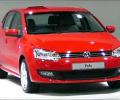
The Indian made Polo has a competitive price and suits the demands of many markets in South East Asia and Africa.
Automakers in India posted their worst growth in recent times in May 2011.
Maruti and Hyundai see marginal rise in demand for entry-level hatchbacks.
Michael Boneham, president, Ford India, said the small car would be engineered for Indian conditions and that the company was keeping options open for both petrol and diesel variants. Ford's mall car will mark its entry into the mainstream segment, popularly known as the B segment cars in India, which accounts for a little over 70 per cent of the 1.3 million India car market.
A majority of HMIL's current export comprises the i10 model, which is exported to Asia, Latin America and Western Europe. In addition, the company has stated that 90 per cent of the i20 model (a premium hatchback) will be exported. The company will produce 150,000 units of the model annually.

Dealers across brands are slashing prices by Rs 20,000 to over Rs 1 lakh, depending on the car model.

The muted expectation of dealers come at a time when vehicle manufacturers such as Maruti Suzuki, Hyundai Motor, Mahindra & Mahindra and others reported a double-digit fall in wholesale dispatches to dealerships in July and August.

In September, JSW MG Motor India, the newly minted joint venture between SAIC Motor, which is present in 100 countries, and Indian conglomerate JSW Group, launched the Windsor, an electric car that introduced battery as a service (BaaS).
